By KureexPublished 6 min read
Deposits are easy everywhere. A venue's behaviour when money tries to leave is the single most informative thing you can learn about it, and it is the only check on this site that requires committing anything.
Test the exit with an amount you would not mind losing, before there is an amount you would.
The test
Fund the smallest amount the venue accepts. Do not trade. Withdraw it to the same place it came from, and note how long it takes and what is asked of you along the way.
The information is not really the delay. It is whether the conditions change: whether something is required at the exit that was not mentioned at the entrance.
The pattern worth recognising
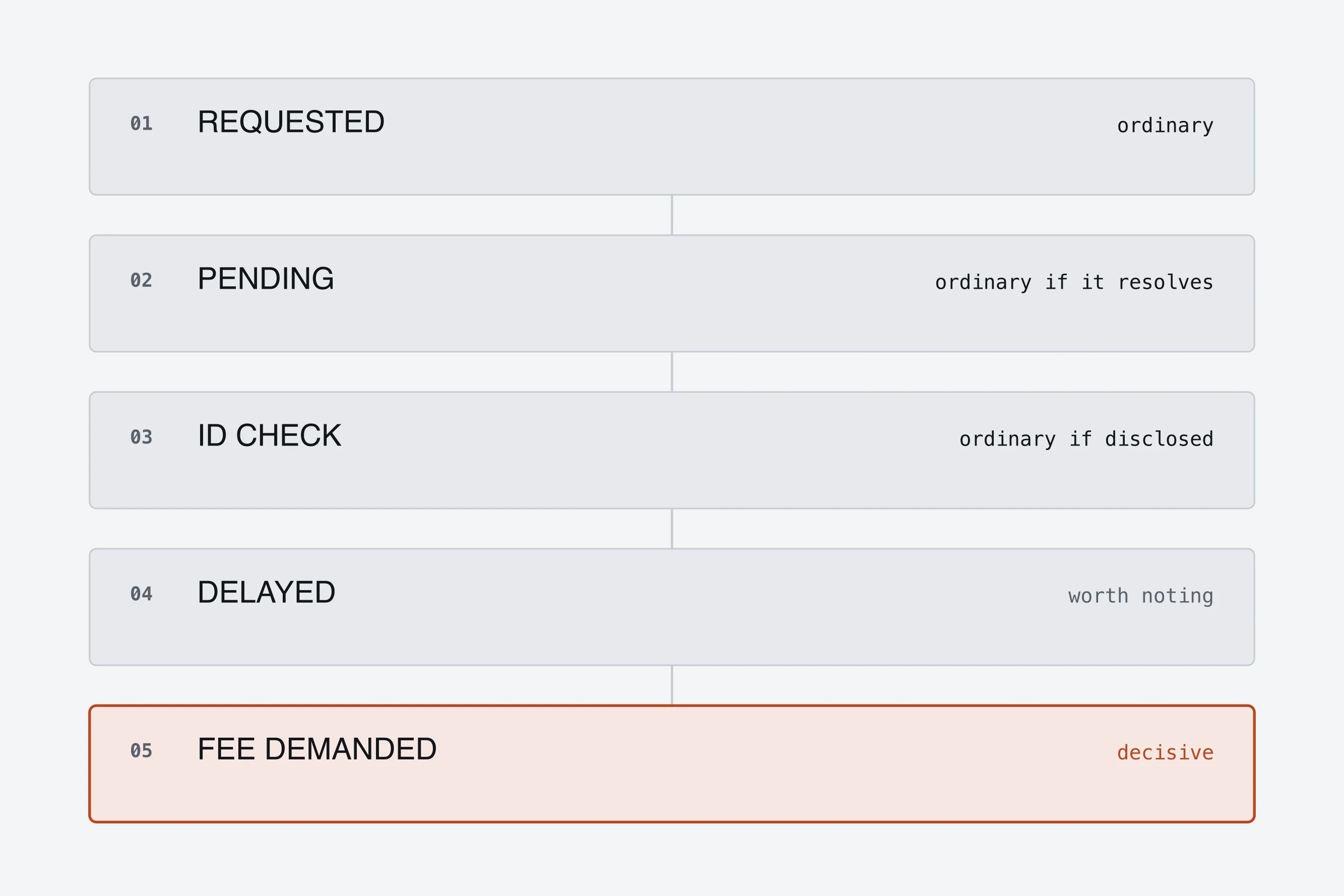
There is a sequence that recurs often enough to be worth naming. A withdrawal is requested and goes pending. A verification step appears that was not required to deposit. Then a fee, a tax, a release payment or a minimum balance is introduced as a condition of the release, payable in advance.
The structure of that request is the tell. A legitimate charge is deducted from the amount being sent. A request for a further payment before funds can move is asking the account holder to send more money to recover money — and it can be repeated indefinitely, because each payment is followed by a new condition.
Delays that are ordinary
Not every delay means anything, and treating all of them as alarming is its own mistake.
- Identity verification requested at first withdrawal, if it was disclosed at signup and applies to everyone.
- A holding period after adding a new withdrawal address, which is a genuine anti-theft measure.
- Network congestion, which affects the blockchain rather than the venue and is visible on a public explorer.
- Banking hours and cut-off times for fiat transfers.
- Scheduled maintenance, if it is announced and finite.
What separates the two
An ordinary delay has a stated reason, a stated end, and applies to everyone. It does not ask for more money.
The other kind arrives only when funds try to leave, is specific to your account, and always has a payment attached.
If a withdrawal has stalled
Nothing here can recover funds and this is not legal advice. The general routes are the payment provider or bank used to fund the account, the financial regulator of the country the entity claims to operate from, and the national fraud reporting service.
One thing applies without exception: people whose withdrawals have stalled are frequently approached afterwards by someone offering to recover the funds for an upfront fee. That is a second fraud working from the same list, and no legitimate recovery process asks for payment in advance.