Check the venue before you fund it

Four questions, in order of how cheap they are to answer

Choosing where to hold or trade cryptoassets is mostly a question about the counterparty, not about the market. Who is holding the money, what a licence actually covers, where the cost really sits, and whether the money comes back out. This site explains those four checks and nothing else: it recommends no venue and has no referral arrangement with any.

  • Who holds the funds, and are client assets separated from the company's own
  • Which entity is licensed, for what activity, and in which country
  • What is charged that is not published as a fee
  • Whether a small withdrawal completes without a new condition appearing

The four checks

Each one answers a different question, and only one of them costs anything

Custody

Whether you hold the asset or the venue holds it for you decides what happens if the venue fails. Most disputes are custody questions wearing another name.

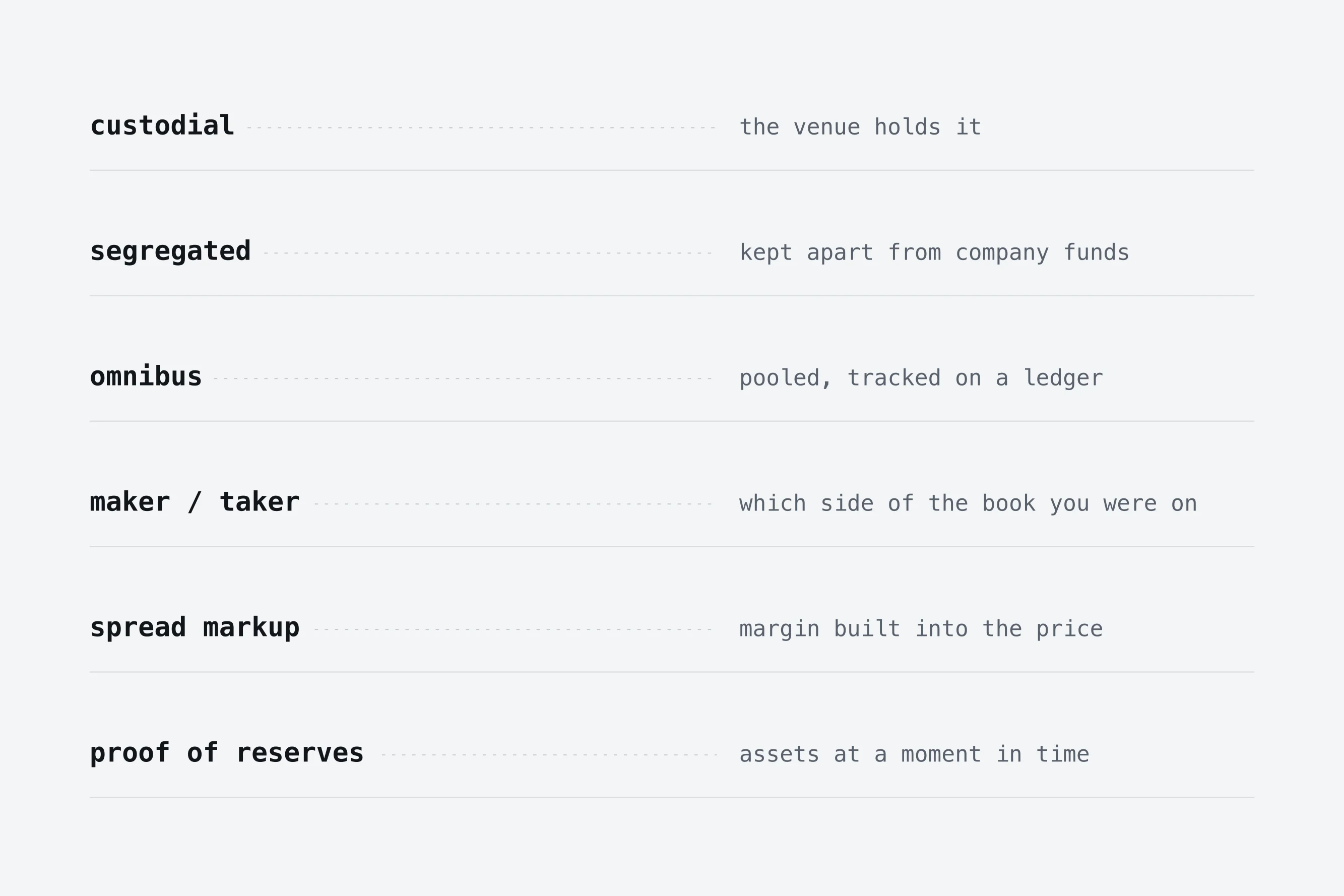
  • Custodial, non-custodial or omnibus
  • Whether client funds are segregated
  • What proof of reserves does and does not prove
Who is holding the money

Regulation

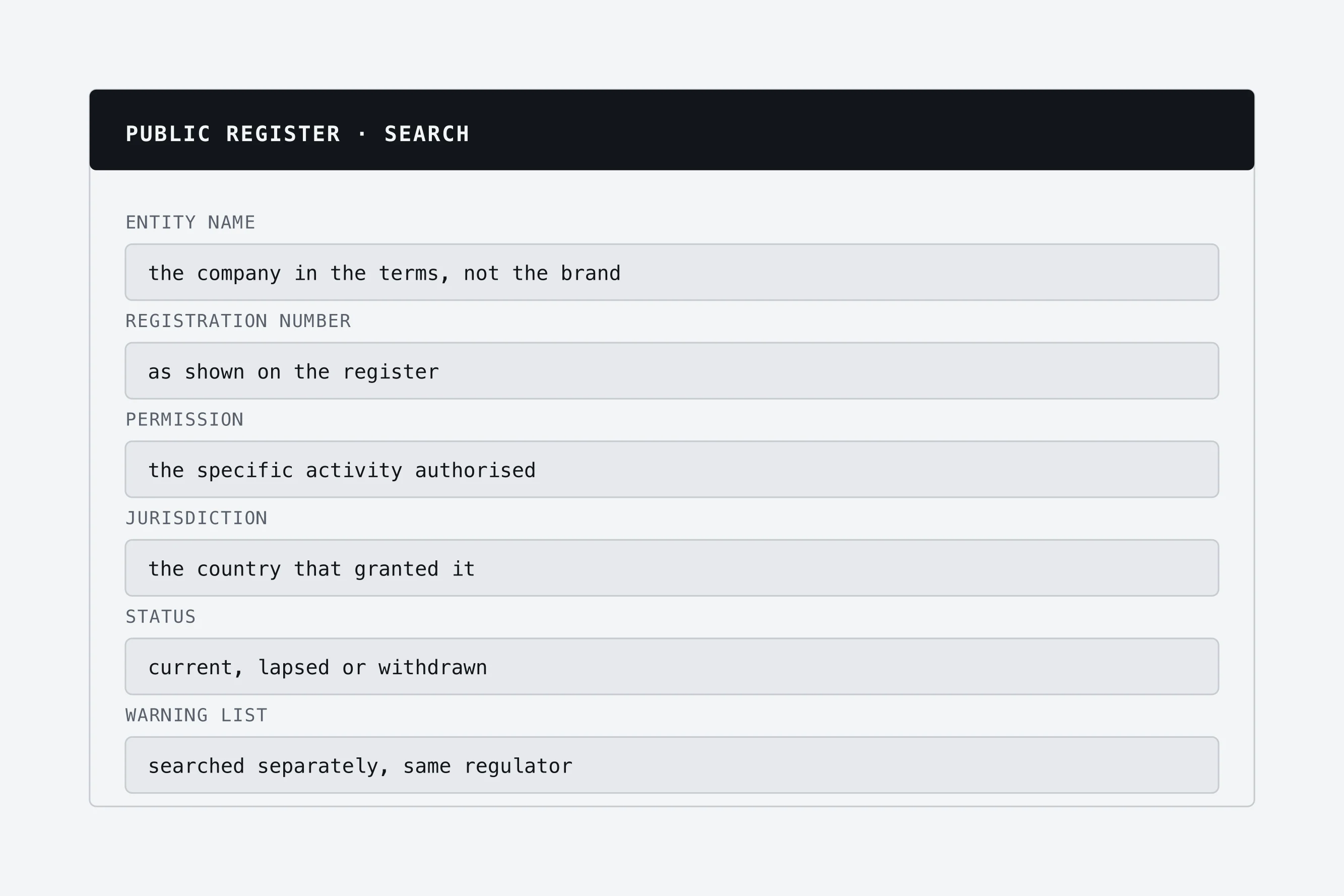
A licence is specific: a named entity, a named activity, a named country. The brand on the website is frequently not the entity on the register.

  • Verifying the claim against the register
  • Which activity the permission covers
  • Public warning lists
What a licence covers

Cost

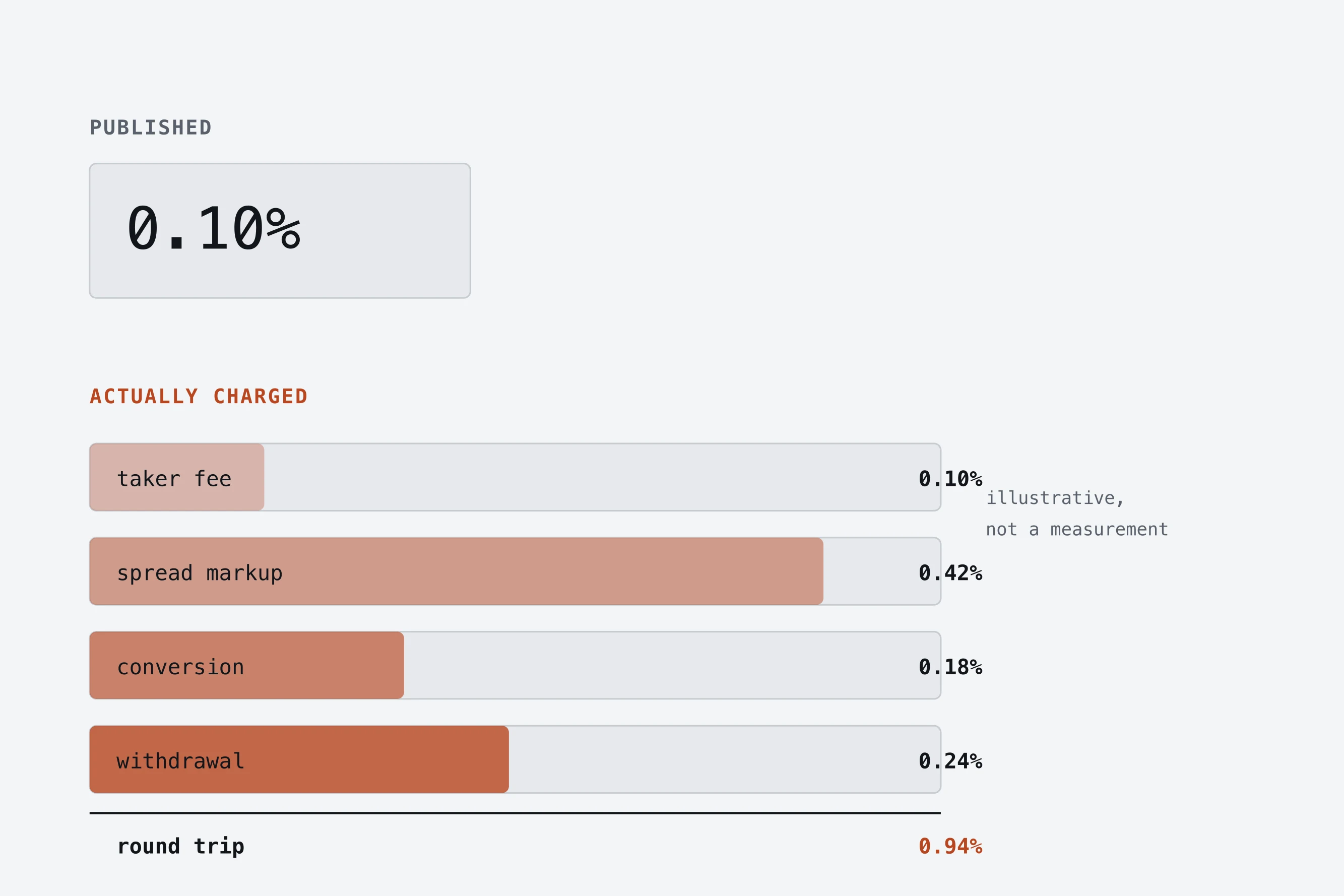
The published fee schedule is rarely the whole cost. Spread markup, conversion and funding are charged without ever being called fees.

  • Maker and taker fees
  • Spread markup on the quoted price
  • Conversion, funding and withdrawal costs
Where the cost sits

Withdrawal

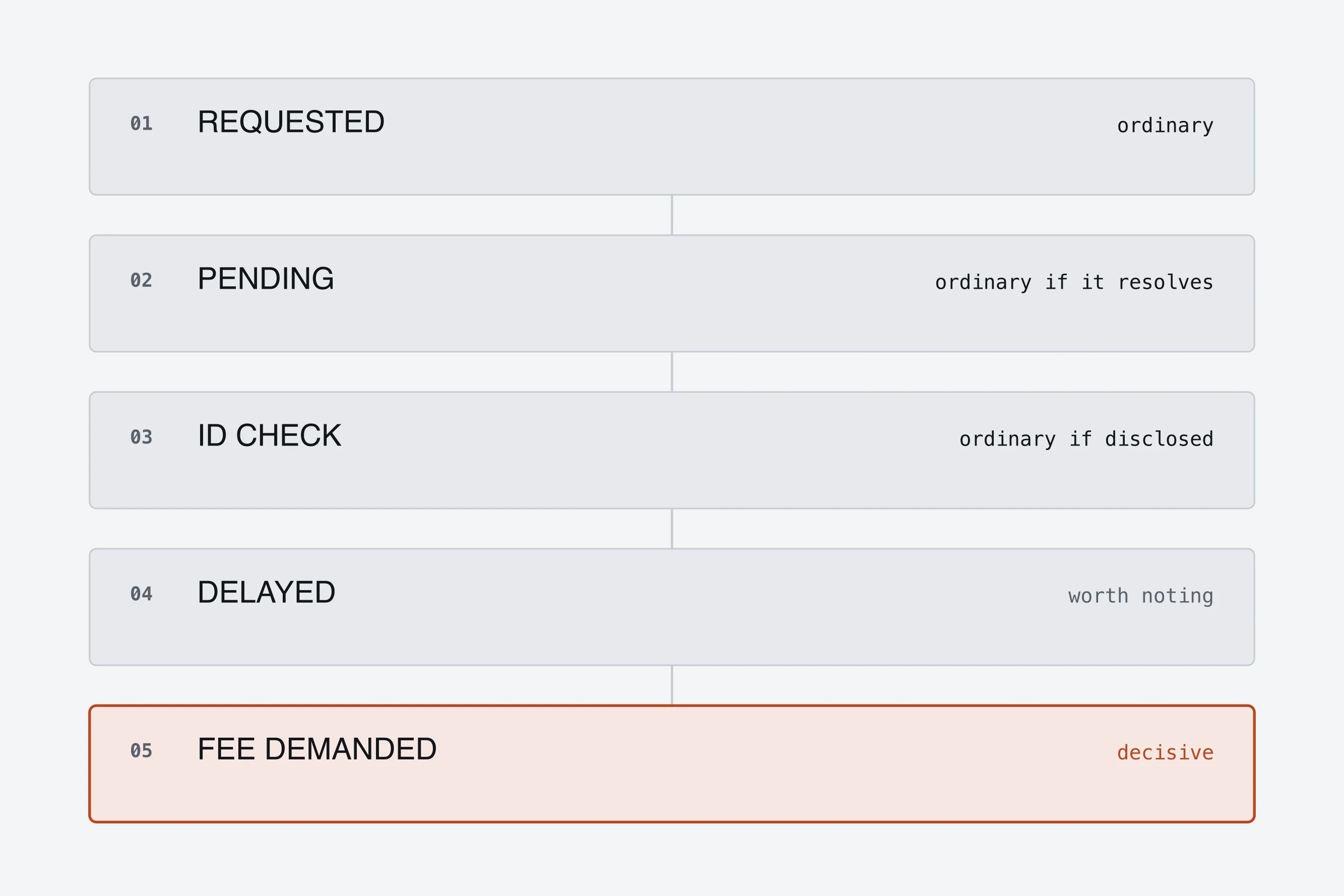
The only check that requires committing money, and the most informative one. A venue that takes deposits smoothly and complicates withdrawals has told you what it is.

  • A small test withdrawal first
  • The delay-and-new-fee pattern
  • What to do when it stalls
The withdrawal test
Start here

Almost every dispute is a custody question

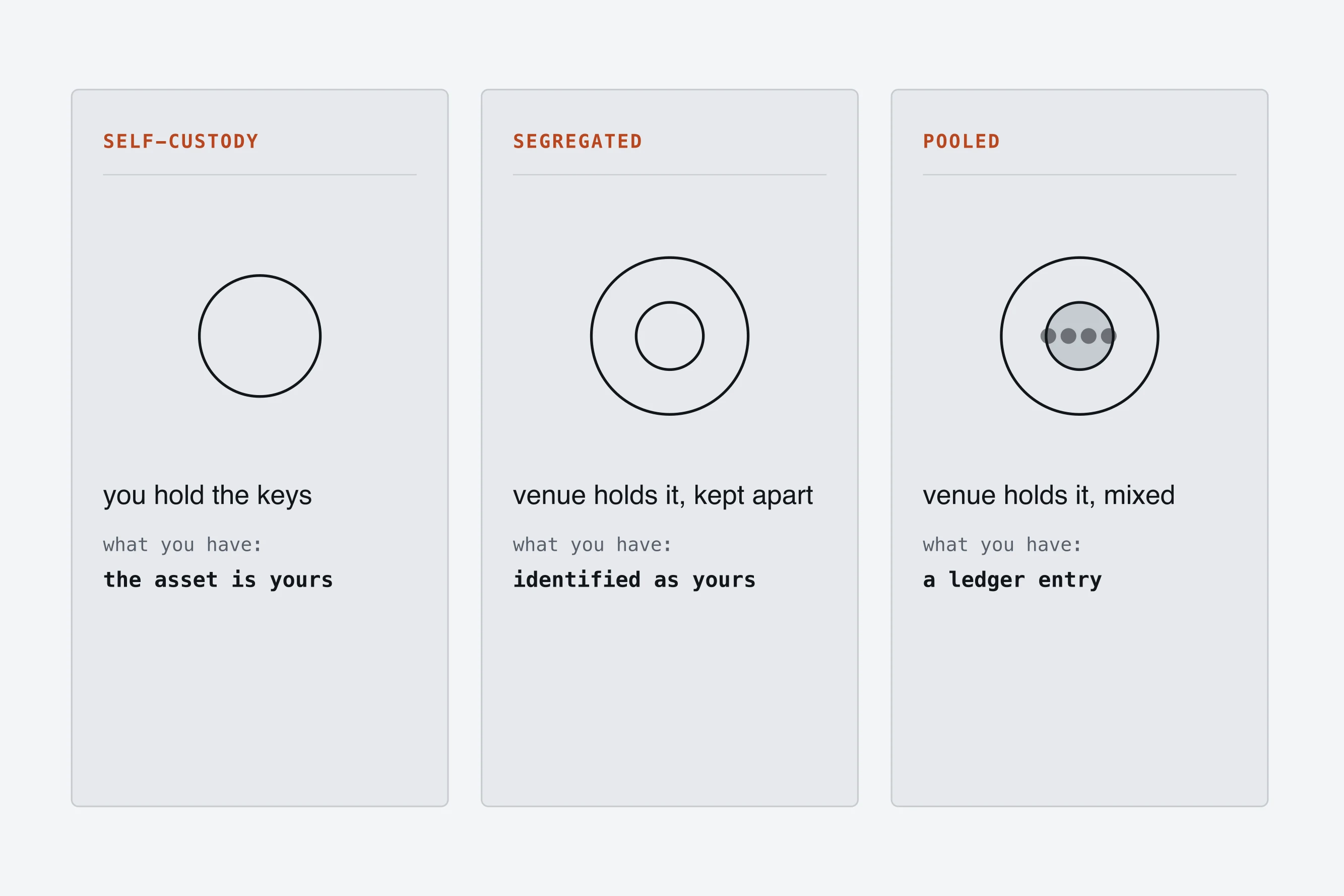
When someone cannot get their money out of a venue, the useful question is rarely whether the platform was good. It is who was holding the asset, under what legal arrangement, and whether that holding was separated from the operator's own money.

If the venue holds it, you have a claim against the venue rather than the asset itself. If client funds are pooled with company funds, that claim is worth whatever is left. If you hold it yourself, the venue's failure is an inconvenience rather than a loss.

Read the custody guide
Diagram contrasting self-custody, segregated custody and pooled custody
Before anything else

The cheapest checks come first

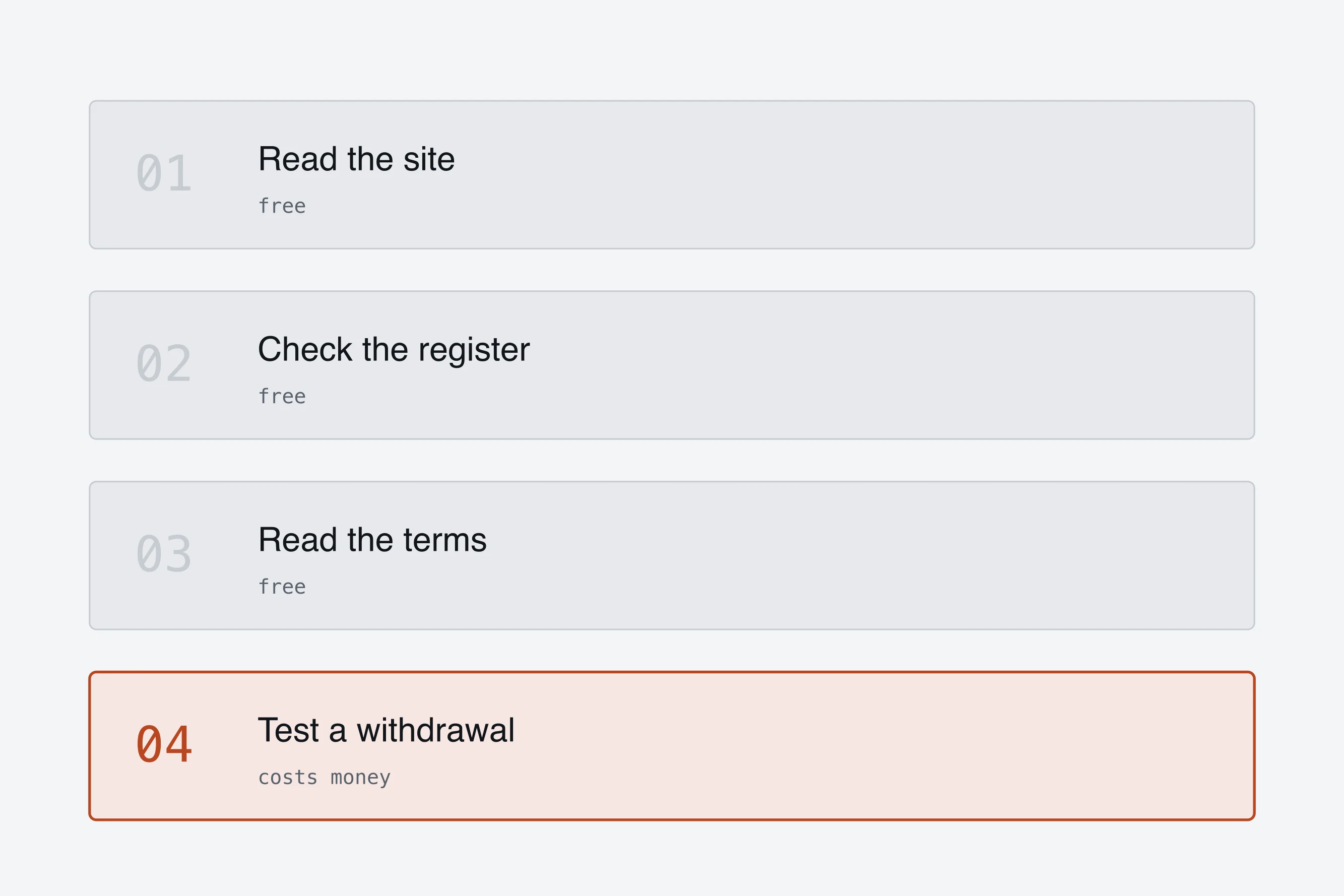
Three of the four checks cost nothing and take a few minutes: reading the terms to find the operating entity, searching that entity on the regulator's register, and reading the fee schedule alongside the actual quoted price.

Only the fourth requires money to be at stake. Doing them in that order means most venues are resolved before anything is committed.

The checklist, in order
Four checks arranged in order of cost, from free to funded

A licence is narrower than it sounds

What a permission usually covers, and what people assume it covers

QuestionWhat a licence typically meansWhat it is often assumed to mean
Who is authorisedOne named legal entity, in one countryThe brand, everywhere it operates
Which activityA specific permission, often registration for anti-money-laundering purposes onlyFull supervision of everything the firm does
If the firm failsDepends entirely on the regime and the product; cryptoassets are frequently outside deposit protectionDeposits are covered like a bank account
If you lose money tradingNot covered — losses from market movement are not a regulatory failureCompensation is available
Where to verify itThe regulator's own public register, searched by entity name or numberThe badge on the website footer
A missing licenceMay be lawful for some activities in some placesAlways illegal, therefore always obvious

In order

The sequence that resolves most venues before any money moves

  1. 1

    Find the operating entity

    The terms or the footer name a company, often different from the brand and frequently registered somewhere other than where the site suggests. That name is what everything else is checked against.

  2. 2

    Search the register and the warning list

    National regulators publish both: a register of authorised firms and a list of firms they have warned the public about. Both are free, searchable and take a minute.

  3. 3

    Read the fee page against a live quote

    Compare the published schedule with the actual price offered on a small trade. The difference between the two is the spread markup, and it is usually the largest cost.

  4. 4

    Test a withdrawal

    Deposit a small amount, trade nothing, and withdraw it. What happens next is more informative than every review you can read.

This site recommends no venue

Not one, not implicitly, and not by omission. It explains the checks so the decision stays with the person making it. The risk notice sets out the limits of everything published here.