By KureexPublished 6 min read
Defined once and used consistently across every page here. Several of these terms are relied upon to sound reassuring to someone meeting them for the first time.
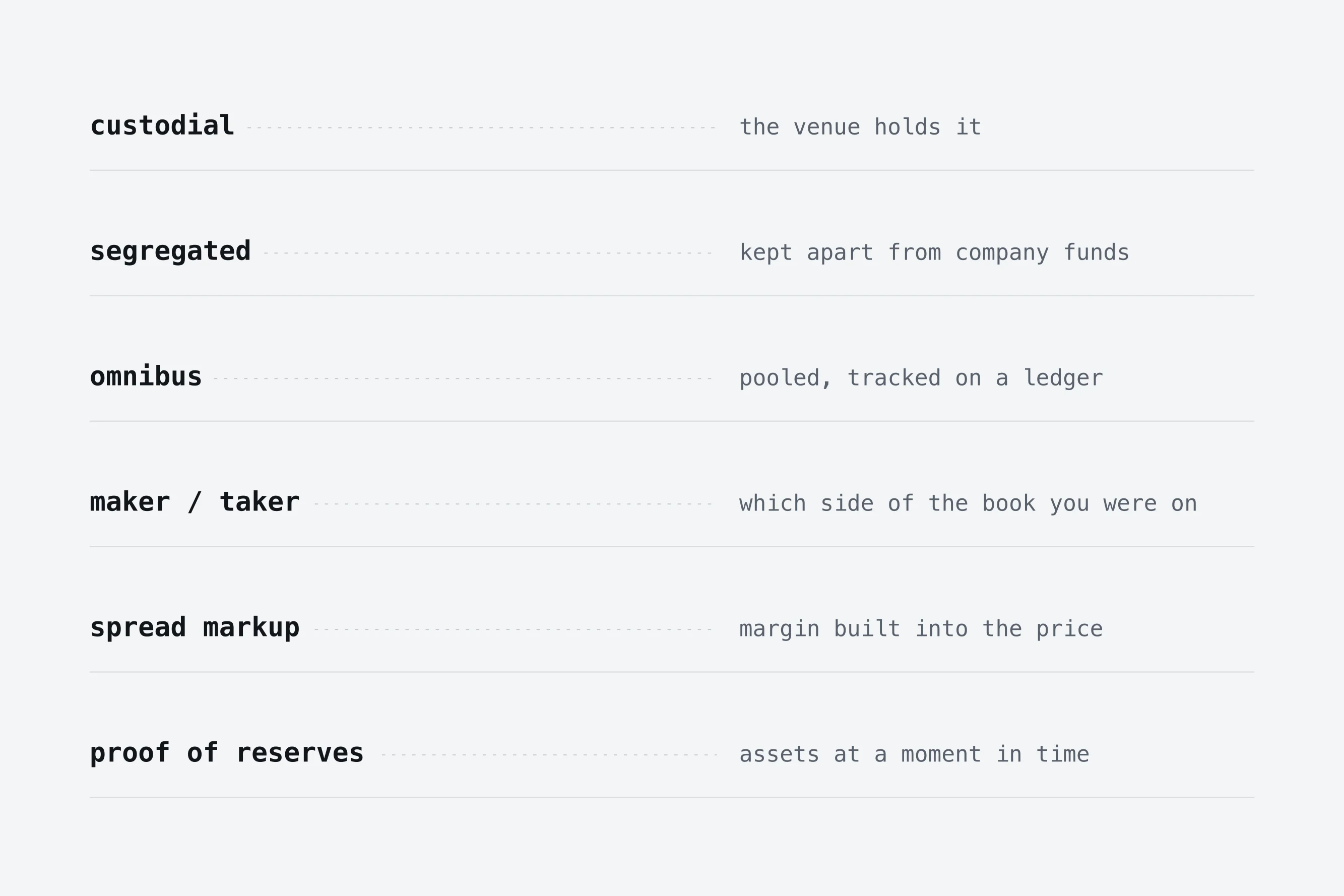
Custody
Who holds the asset, and under what arrangement.
- Custodial — the venue holds the asset on your behalf. You hold a claim against the venue.
- Non-custodial or self-custody — you hold the private keys. Nobody can freeze the asset and nobody can restore it for you.
- Segregated — client assets are kept separate from the operator's own and identified as belonging to clients.
- Omnibus or pooled — client assets are held together in shared wallets, with an internal ledger recording who owns what.
- Rehypothecation — the venue reusing client assets for its own purposes, such as lending them out.
- Proof of reserves — evidence that a venue controlled certain assets at a moment in time. Stronger when it also covers liabilities and is independently performed.
Regulation
What a permission is, and what it attaches to.
- Register — the regulator's own public list of authorised firms, searchable by name or number.
- Warning list — the regulator's public list of firms it has warned the public about.
- Operating entity — the named company you are actually contracting with, stated in the terms and frequently not the brand.
- AML registration — supervision for anti-money-laundering purposes, which is not authorisation of the investment activity.
- Deposit protection — a compensation scheme covering certain deposits on a firm's failure. Cryptoassets are frequently outside it.
Cost
Every place the money goes.
- Maker fee — charged on an order that rests in the book and adds liquidity. Usually the cheaper side.
- Taker fee — charged on an order that executes immediately against the book.
- Spread markup — margin built into a quoted price rather than charged as a fee. On zero-commission venues this is usually the whole cost.
- Funding rate — a periodic payment between long and short holders of a perpetual contract, set by the imbalance between them.
- Conversion margin — the difference between the rate applied to a currency conversion and the market rate.
- Network fee — paid to the blockchain rather than to the venue, and worth separating from the venue's own charge.
Withdrawals
The vocabulary of the exit.
- Test withdrawal — a small withdrawal made deliberately to observe how the venue behaves before committing more.
- Pending — requested and not yet sent. Ordinary in itself; informative when it does not resolve.
- Address whitelisting — a holding period after adding a new withdrawal destination, which is a genuine anti-theft measure.
- Release fee — a payment demanded before funds can be sent out. A legitimate charge is deducted from the amount, not requested in advance.
- Minimum withdrawal — a floor below which funds cannot be moved, which can strand a small balance.