By KureexPublished 8 min read
Almost every dispute about a crypto venue is a custody question in disguise. Not whether the platform was good, but who was holding the asset, under what arrangement, and whether that holding was kept apart from the operator's own money.
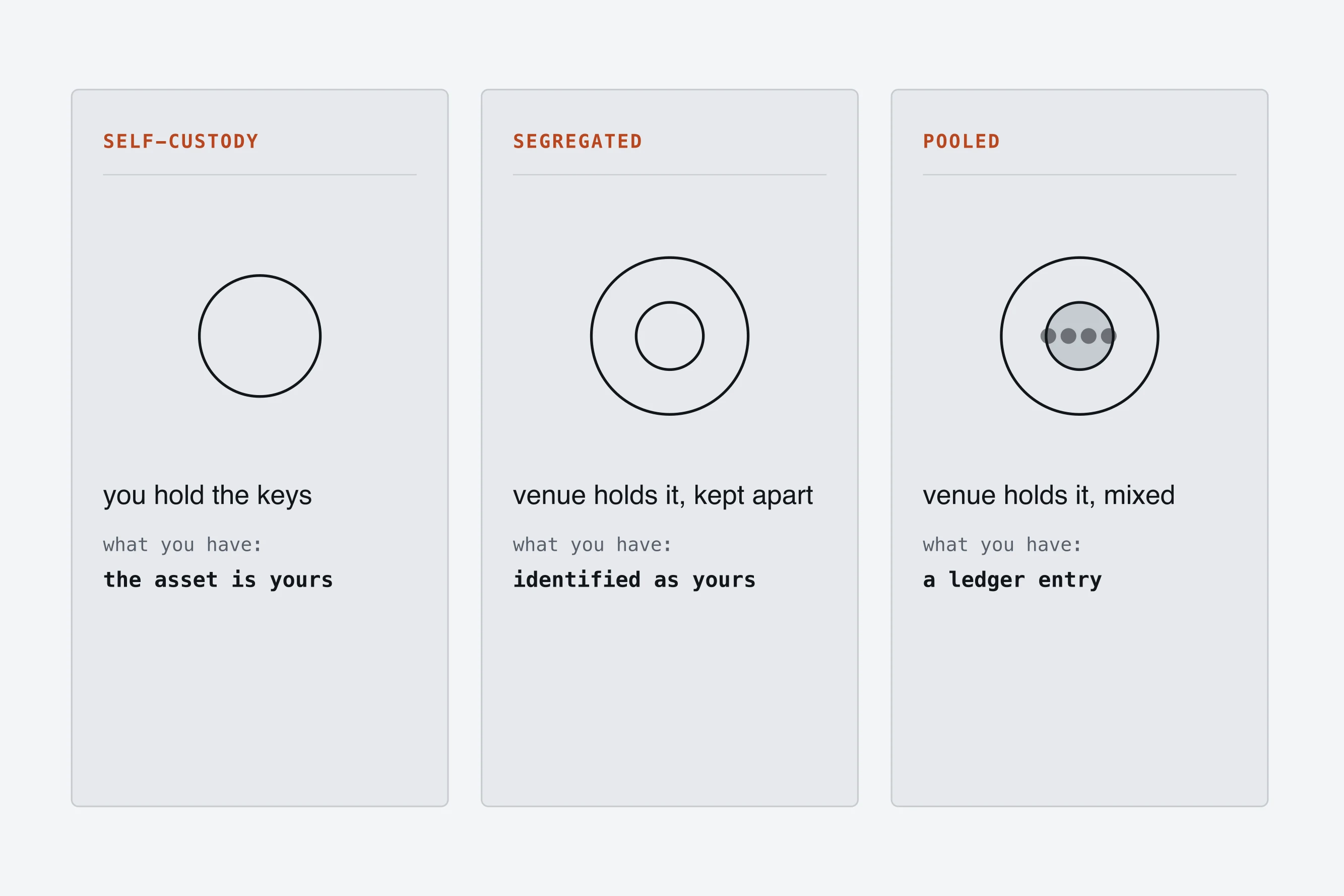
If the venue holds it, you hold a claim against the venue rather than the asset.
The three arrangements
From inside an account they are indistinguishable: a balance, a number, a withdraw button. Legally they are not remotely the same thing.
- Self-custody. You hold the private keys. Nobody can freeze or lend the asset, and nobody can help you if you lose the keys.
- Custodial, segregated. The venue holds the asset for you, and client assets are kept separate from the company's own, usually with records identifying whose is whose.
- Custodial, omnibus or pooled. The venue holds client assets together in shared wallets and keeps its own internal ledger of who owns what. Common, and entirely dependent on that ledger being accurate and honoured.
Why segregation is the word that matters
Segregation is the difference between an asset being yours and being owed to you. Where client assets are properly separated and identifiable, a failure of the operator is more likely to leave those assets recoverable rather than swept into a general pool of what the company owns.
Where they are not, the position is frequently that of an unsecured creditor: standing in a queue with everyone else the company owes money to. That distinction rarely appears in marketing and is usually stated somewhere in the terms.
What proof of reserves does and does not prove
A proof-of-reserves exercise shows that a venue controls a quantity of assets at a moment in time. That is worth something, and it is much less than it is often presented as.
It is a snapshot, so it says nothing about the day before or after. On its own it shows assets without showing liabilities, and a venue with more customer obligations than assets can still pass an assets-only check. It also does not establish that the assets are unencumbered rather than borrowed for the occasion.
The version worth more is one that covers liabilities as well, is performed by an independent party, and is repeated on a schedule rather than once.
Questions the terms will answer
These are answerable by reading the venue's own documents, which is free and takes longer than most people give it.
- Which named entity holds client assets, and where is it incorporated?
- Are client assets segregated from the operator's assets, and is that stated as a commitment or described as an intention?
- Can the venue lend, stake or rehypothecate client assets, and is consent assumed by default?
- What happens to client assets on insolvency, in the venue's own words?
- Is there an insurance arrangement, what does it cover, and up to what limit?