By KureexPublished 7 min read
A financial venue that has not finished editing its own website has told you something about how much else is unfinished. These tells cost nothing to look for and are visible before any account exists.
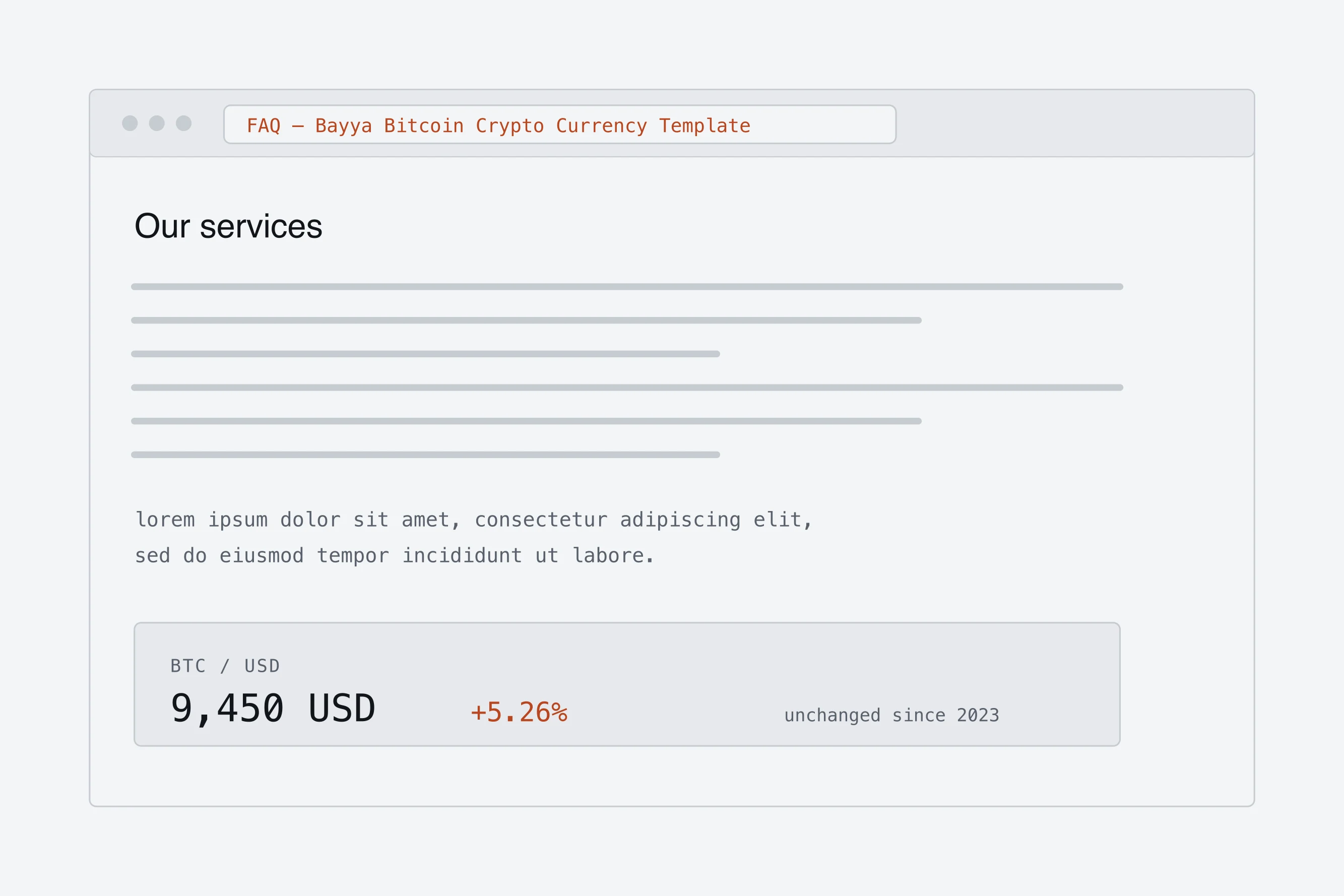
A site is not evidence of a business. It is evidence that somebody bought a template.
The template's own name, still in the title bar
Commercial website templates ship with demo titles. Editing them is a two-minute job that a real operator does before launch and a disposable one does not bother with.
It is visible in the browser tab and in the page source, and it usually survives on the pages nobody troubles to update: pricing, FAQ, contact, 404.
Placeholder Latin
Lorem ipsum in a service description means the service was never described. On a venue asking for deposits, a services page whose descriptions are placeholder text is not a rough edge; it is the answer.
The same applies to obviously untouched demo content: staff biographies with generic names, offices in cities the company has no connection to, and testimonials attributed to placeholder people.
A price ticker that never moves
Many templates ship with a decorative market ticker containing fixed numbers. On a real venue these are live. On a template they are text.
It is trivial to check: leave the page open, reload it, or compare the figure against any public price. A quoted price that is identical across days is not a data feed.
Contact details that lead nowhere
The contact page is usually the least edited page on a disposable site.
- An email at a domain that is not the venue's own, or an address left from the template.
- A phone number in a country unrelated to the stated head office, or several in different countries.
- An address that resolves to a virtual office, a residential building or nothing at all.
- A contact form that posts nowhere, which is visible in the page source.
- No named legal entity anywhere on the site, including in the terms.
Things that look like proof and are not
Certain reassurance devices are decorative by default in most templates: trust badges that are images rather than links, security logos naming an encryption standard, award graphics with no issuing body, and press logos with no article behind them.
The test is whether each one leads anywhere. A genuine certification links to a verifiable record held by whoever issued it. A picture of a badge is a picture.
What this does and does not prove
A polished site proves nothing either — well-funded frauds have excellent websites, and some legitimate small operators have scrappy ones.
These tells are cheap negative evidence, not positive evidence. They can tell you quickly that something is not worth further time. They cannot tell you that anything is safe, which is what the register lookup and the withdrawal test are for.