By KureexPublished 7 min read
The published fee schedule is the part of the cost a venue chooses to call a fee. On many platforms it is not the largest part, and on some it is close to irrelevant.
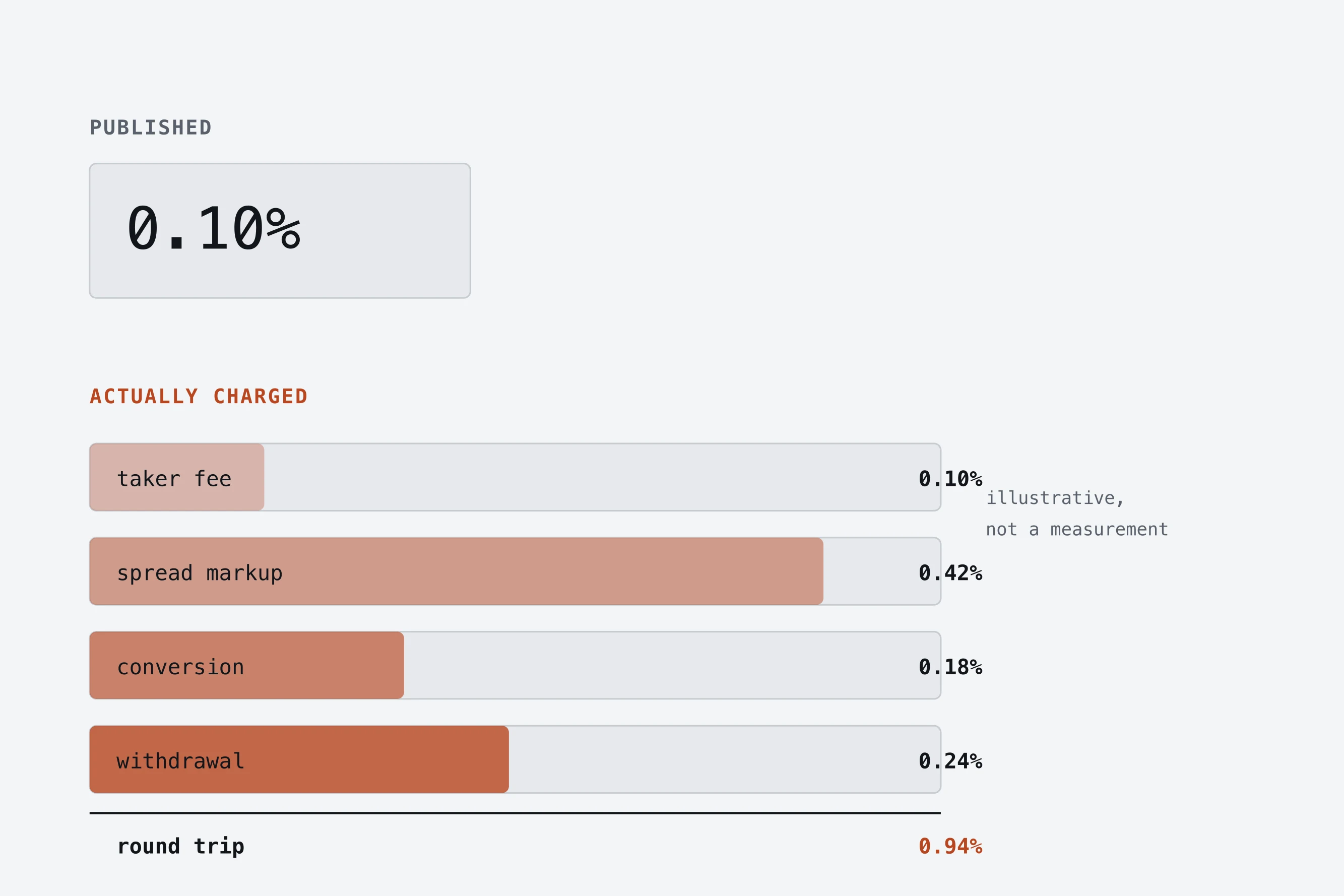
Compare the schedule against a live quote on a small trade. The gap is the cost nobody advertises.
Maker and taker
On an order-book venue, an order that rests in the book and waits is a maker order; one that executes immediately against what is already there is a taker order. Taker fees are normally higher, and sometimes maker fees are rebated.
This is the part that appears on the fee page, is stated as a percentage, and is usually the easiest cost to reason about.
Spread markup, which is not called a fee
A venue that quotes you a single price rather than showing an order book can build its margin into the price itself. The quote you are offered to buy is a little above the market and the quote to sell a little below, and the difference is revenue that never appears on a fee schedule.
On "zero commission" venues this is generally where the entire cost lives. The only way to see it is to compare the quote against the price on a venue that publishes a book, at the same moment, for the same size.
Conversion
If the account is denominated in one currency and funded in another, a conversion happens, and the rate applied is usually not the interbank rate. The margin on that conversion is charged on the way in and again on the way out.
This is easy to miss because it is presented as an exchange rate rather than as a charge.
Funding and financing
Leveraged and perpetual products carry a periodic financing charge for as long as the position is open. On perpetual futures the rate is set by the imbalance between long and short interest, so the crowded side normally pays.
This cost accrues quietly. It is not visible at entry or at exit, which is where most people look for costs.
The costs at the edges
These sit outside the trade and are frequently where the surprises are.
- Deposit fees, including card-funding charges that can be several times a trading fee.
- Withdrawal fees, sometimes fixed and sometimes well above the underlying network cost.
- Minimum withdrawal thresholds, which can strand a small balance permanently.
- Inactivity or account maintenance charges, usually stated in the terms and nowhere else.
- Network fees, which are real and payable to the network rather than the venue — worth separating from the venue's own margin.
How to see the total
Fund a small amount, buy, sell immediately, and withdraw. The difference between what went in and what came out is the whole cost of a round trip on that venue, including every part of it that is not called a fee.
It is the same exercise as the withdrawal test and answers two questions at once.